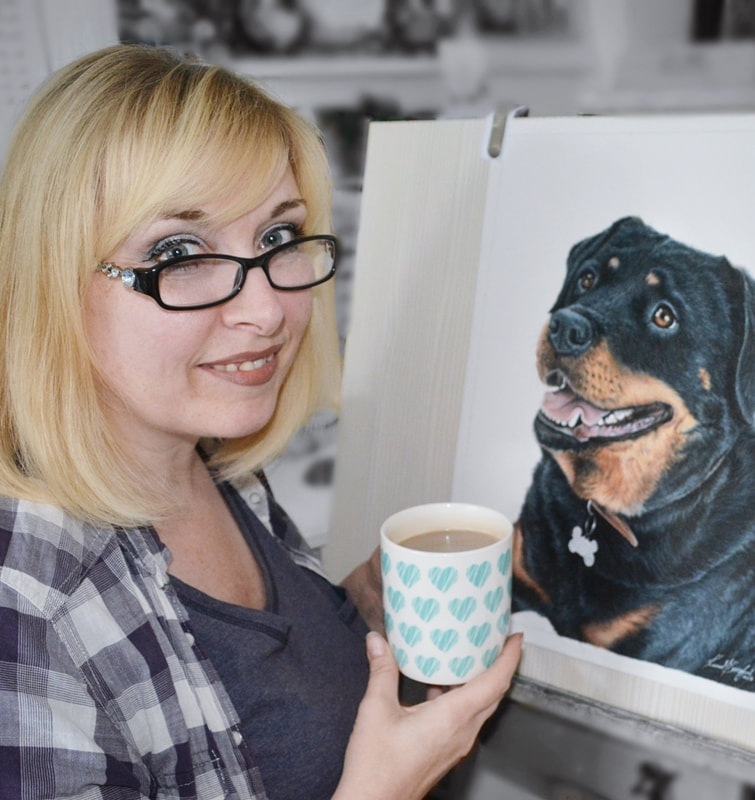


The creation process of my acrylic pet paintingsI'd like to share the process involved in creating my acrylic paintings. Even when I have several dog portraits on the easel, my method remains consistent, however, I may choose to enhance the artwork by incorporating different mediums or adding specialist colours. Here are two of my latest dog portraits: one features a Springer Spaniel swimming, and the other, a young female white Boxer. Springer Spaniel - Acrylic Painting on Ampersand Gessobord - Size: 11" x 14"Creating an acrylic portrait involves significant transformations of the artwork. I make it a point to photograph the painting at various stages. Observing the evolution of the painting is not only intriguing but also serves as a valuable tool to demonstrate its progression to others. In this segment, I will detail the process behind the creation of a painting featuring our Springer Spaniel, Casper. This piece is one of a quartet, each illustrating our dogs in water, which will be displayed together upon completion. Laying the Groundwork: Tonal Foundations and ContrastIn all my artwork, I begin with the foundational layers, starting by establishing tones and introducing contrasts. Initially, it may appear quite chaotic, but this process is essential for building upon these initial layers. This stage is critical for establishing tonal values and focusing on the different elements that make up the subject. Refining the Subject: Enhancing Form and PrecisionAt this current stage, the detail is somewhat lacking in precision, however, it could potentially be perceived as a more exaggerated interpretation of a subject. As an artist who relishes a challenge, I then move forward to further refine the painting in order to render the main subject with a greater sense of realism, ameliorating both the finer details and overall appearance. Balancing Realism and Interpretation in Photo-Based WorkMy paintings maintain a realistic quality whether viewed from afar or up close. However, not all of my works require the same level of precision; at times, a more relaxed interpretation yields a better result. Working from photographs often means dealing with images that aren't high-resolution and may lack essential details. This propels me into the exciting challenge of finding a balance between realism and artistic interpretation.
Achieving the correct contrast can give a painting a three-dimensional appearance, even when viewed from a flat angle.
Now, let's explore the creation of another acrylic painting, featuring a charming little white Boxer puppy named Sprout. White Boxer Pup - Acrylic Painting on Ampersand Gessobord - Size: 8" x 8"At 8" x 8", this small painting is perfect for an intimate depiction of a nine-month-old Boxer puppy named Sprout. Recently welcomed into her new home with four other Boxer dogs, Sprout, like many puppies, dozed off in an unusual spot, snug in the bend of a friend's arm, with her little head resting in their hand. Choosing to craft a monochromatic portrait against a stark black backdrop guarantees that the attention is solely on the subject. Establishing Fur Flow and Tonal StructureDuring this preliminary phase, I carefully incorporate the fur details in a general manner to illustrate the flow and texture of the fur. Furthermore, I tentatively arrange the highlights and shadows, laying the groundwork for the meticulous addition of more intricate details in the next phase. Layering Detail with Precision BrushworkHere, the two stages are evident: the first with a thicker application, followed by a second with a finer touch. Each hair is individually painted using an ultra-fine brush, with a rigger brush being the perfect tool for such detailed work. To achieve a natural flow in the application of each hair, I rotate the canvas board as needed, even working upside down at times. Refining Contours and Preparing for Final VarnishHere, the fineness of the fur is evident. Although the painting is incomplete, the meticulous addition of each hair strand showcases the intricate contours of the Boxer dog's mouth and nose region. The concluding phase involves meticulously detailing the hand, and upon completion, the painting will be sealed with two layers of varnish for maximum preservation.
Thank you for exploring my article on how I create my acrylic paintings. Should you wish to commission a custom portrait, you can click any of the links below to visit the pages of interest. There, you can peruse my previous works, learn about the commissioning process, and either request a quote or book directly using the form. Alternatively, you can contact me direct at: [email protected]
0 Comments
Your comment will be posted after it is approved.
Leave a Reply. |
AuthorKaren M Berisford Choose tags below to search the news blog directory, or quickly find each blog through the News Blog Archives page.
Categories
All
Archives
July 2025
|
|
|
Looking for something specific?
|
|
|
Images and text within this website are Copyright of Karen M Berisford 2010 - 2026
No content should be used, copied or distributed in any way without express consent from Karen M Berisford


